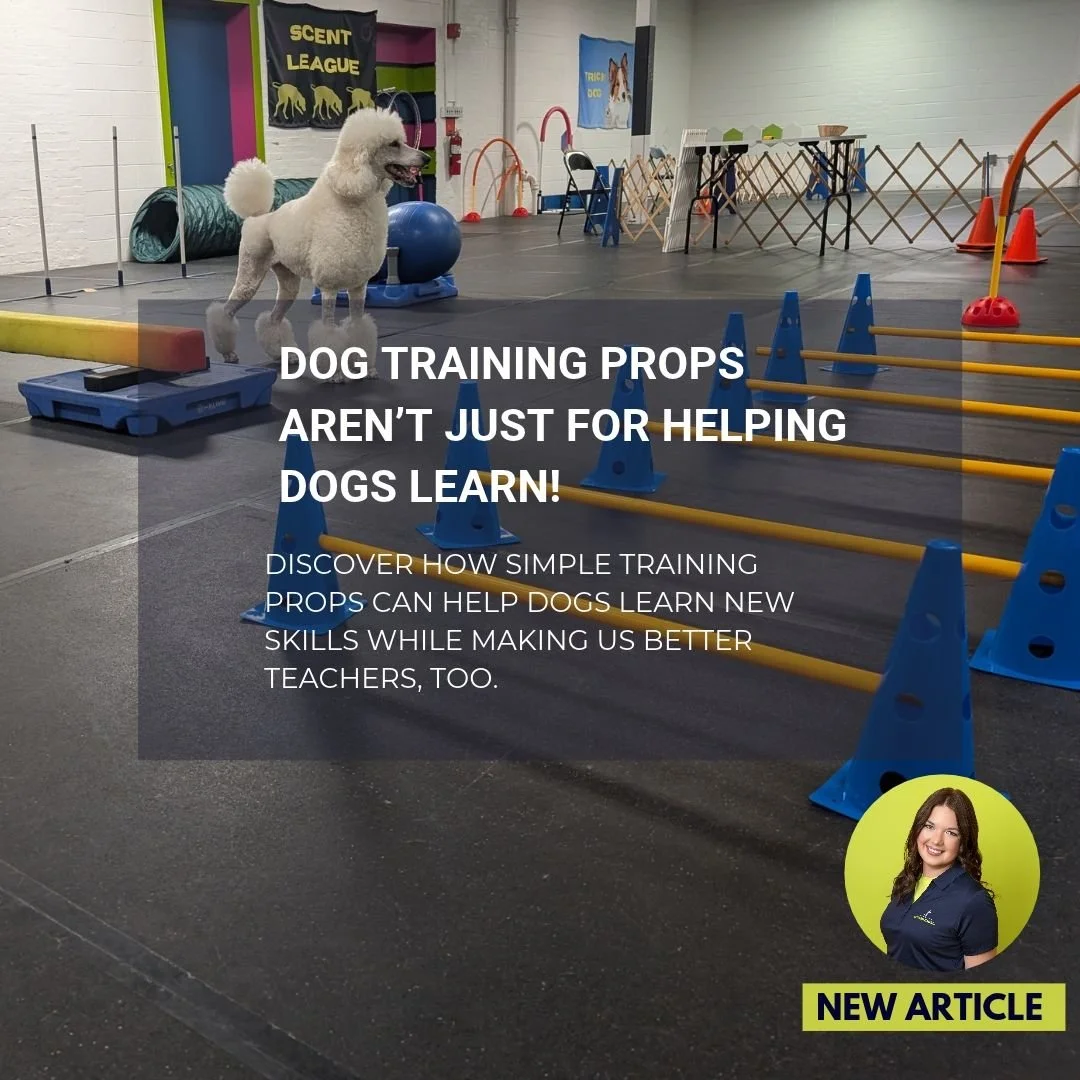
When I’m about to train a dog to do something new, I think about the setup first. Dogs trained frequently might not be distracted by extra props and nearby distractions while learning a new skill, but the training setup should still help the dog easily find the right answer. You should remove distractions and training props you won’t be using. The way we want a dog to focus while learning something completely new reminds me of how we also use props intentionally to help the trainer focus.
Many types of training props are used. We train dogs to step up onto buckets, hop onto platforms, go through hoops, touch targets, and more. It’s important to train clear cues so the dog doesn’t rely on the prop’s appearance to tell them what to do. When your dog sees a platform, it shouldn’t automatically mean jump on unless you give the “place” cue. This matters for safety. You don’t want your dog launching themselves at objects unexpectedly.
One game I use to test a dog’s understanding of prop-related cues is giving different cues for the same object. For example, have a dog circle a platform, target it with their nose, and jump on it. The dog has to listen carefully for instructions. This is just one example using common Trickovation micro-skills, but you can use other behaviors as well.
When teaching a dog something new, the picture is different than when working on what they already know. You don’t have a way to easily tell the dog what to do, yet. If you’re using a prop, keep it on its own so your dog isn’t guessing which one is involved if there are other props in the training space. Dogs quickly learn the context of shaping when they can offer behaviors without a cue during training, but you want to help your dog by eliminating guesses that don’t make sense.
Props can help you train many different skills. If your dog knows how to step onto a bucket, you can use that to train steadiness for a stand-stay, pivots for heelwork, and more. If your dog can go around an object, you can use that skill to work on a down at a distance by sending your dog out and then giving the down cue. Props can help clarify things for more than just dogs, though.
As an instructor, I often use props to help break down exercises for my students. When teaching distance and balance for obedience position changes, I might have students leave their dogs in the step-up position with their paws on a step or bucket, then toss a treat for the dog to catch. There are too many examples to include, and the list keeps growing as I teach Trickovation drills to so many students.
Remember when I said it can help the dog focus on the prop we use by removing the others during the learning process? It’s the same for people. We can train many things without any props. We can use treat tosses to get a dog to spin (if luring isn’t the preferred method for the individual), but we can also place a target behind the dog so the dog turns to touch the target, then finishes the turn toward the handler to teach spin. The difference is that the target can help the human learner. When we have something to focus on and zone in on, it can improve our timing, help us visualize the movement we want, and make the training process easier. I suggest moving props that you aren’t using out of your field of vision and focusing on just the one during the early training process for new skills. This small change can improve reward timing in interesting ways.
Training is never just about the dog, and as our dogs’ teachers, we should always find ways to communicate clearly and support them. Using props to train skills, even if the prop isn’t involved in the final skill, can be an excellent approach. The next time you’re trying to train something new, you might want to think about what your dog already knows involving props and consider whether there’s an easier way to get to the end result.
