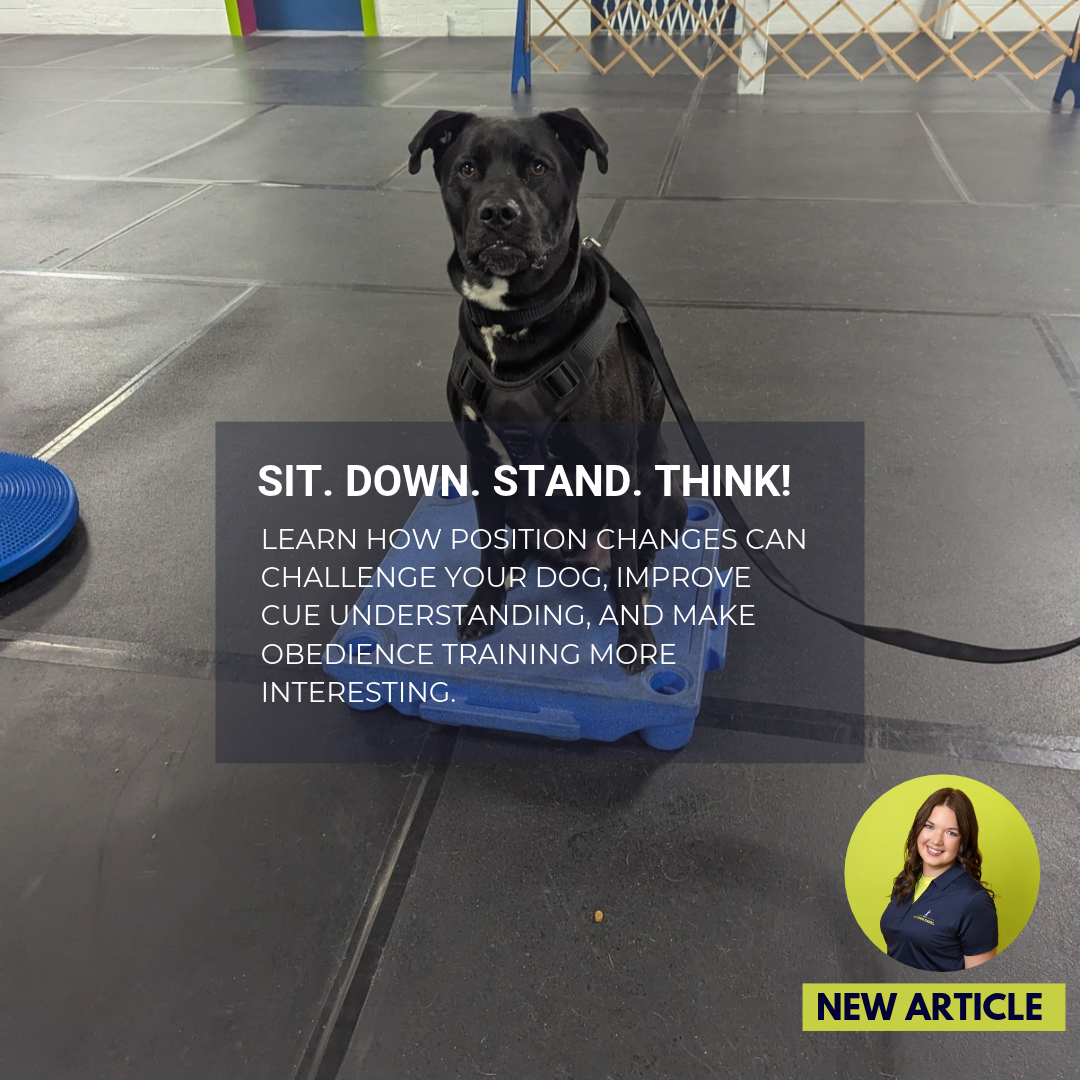
Whether you’re just beginning to train your dog or already working on advanced skills, you’ve probably spent time working on obedience position changes, also known as command discrimination. Training your dog to sit, lie down, and stand on cue seems simple enough, but it gets challenging once you add distance between you and your dog and require precise movements. This challenge is part of what makes the drill rewarding for many people, but the benefits go beyond building your training skills.
What Are Position Changes?
Position changes require the dog to switch between positions on cue. The dog remains in place without walking or even taking a step or two toward the person. With the front paws in about the same position throughout, the dog will sit, push their hips back as they drop into the down, and stand up by either rising straight up from the down or kicking their back paws out as they pop up from the sit. The stand does not involve standing up on the hind legs. Instead, picture your dog standing naturally and balanced, with all four paws on the floor.
Another version of this exercise requires the dog to move between positions while keeping their back paws in the same spot as the front paws move instead. With either version, the dog must learn how to work at a distance from the handler if you ever want to try long-distance position changes. The handler gives the cues randomly so the exercise doesn’t become predictable.
Different Ways to Train It
If you taught your dog to sit by holding a treat high enough that your dog looks up and then naturally sits, and you taught down by bringing a treat to the floor and slowly sliding it out, then you might lean toward using a similar technique to train stand. The problem with training stand by luring is that if you bring the lure forward to get your dog to step into the standing position, your dog will begin to walk into the stand instead of raising up. Since the end result is for the dog to stay in place, how you train it matters from the start.
If you use luring to get your dog to stand from the sit, you want to bring the lure toward your dog so that your dog looks down, kicks back, and then stands up. Another method we use at MJ’s Pet Training Academy is a target that the dog touches with their nose. The nose target is one of the Trickovation micro-skills that helps with training many different behaviors.
If your goal is to train position changes with precision, think about how your dog moves while you’re training each position. It takes practice and even a bit of fitness for dogs to easily move between positions while remaining in place.
Why Train Position Changes?
When testing your dog’s understanding of cues, it helps to work with more than two positions. Three core positions mean your dog isn’t just switching back and forth between two. Of course, you can add additional movements to further challenge your dog.
The exercise is part of AKC Obedience, so if you plan to compete, it’s important to train. For everyday use, it’s a great way to get some training in even when you’re short on time. You can work on the drill almost anywhere without needing much space.
Another benefit is that it lets you measure your dog’s responses to cues. Does your dog respond to the first cue you give each time, even without treats in your hand? Does your dog get it right? Can your dog respond when you’re standing several feet away? You can measure and analyze all of these over time.
Make It More Interesting
To make the drill more interesting, try combining position changes with backing up. So many dogs will move forward toward the person giving the cues as they move between sit, down, and stand. What if, instead, you remain still and cue your dog to back up?
First, teach a strong back-up cue so your dog knows how to move away from you. Then you can give a series of cues such as sit, back, down, back, and then stand.
This will get your dog moving and thinking. Used correctly, it can even improve your dog’s responses during position changes.
What About Using a Release Word?
When you tell your dog to sit and then tell your dog to down or stand, you don’t have to use the word “break” in between. The dog can’t do both at the same time, so you don’t need to release the dog between each cue. Use “break” on the last cue. Your dog should also learn to stay in each position without always switching between them.
Ready to give it a try?
