You know the feeling when the answer is just on the tip of your tongue? It’s like you know what you want to say, but something is keeping you from landing on the right answer. Then someone gives you a hint. It clicks, and you have that feeling of, “I knew it. That’s what I was thinking.” It’s almost rewarding to know you were on the right track.
When it finally clicks, you’ll most likely feel like you were so close to being right that you weren’t wrong.
I’ve been thinking about how this applies to dog training. When we’re working on a skill the dog is confident with, we can set surprisingly precise rules the dog must meet to earn a reward.
A few examples:
The dog responds to the cue within two seconds.
The dog lands in the correct position.
The dog performs the behavior with enough enthusiasm or speed to meet our criteria for reinforcement.
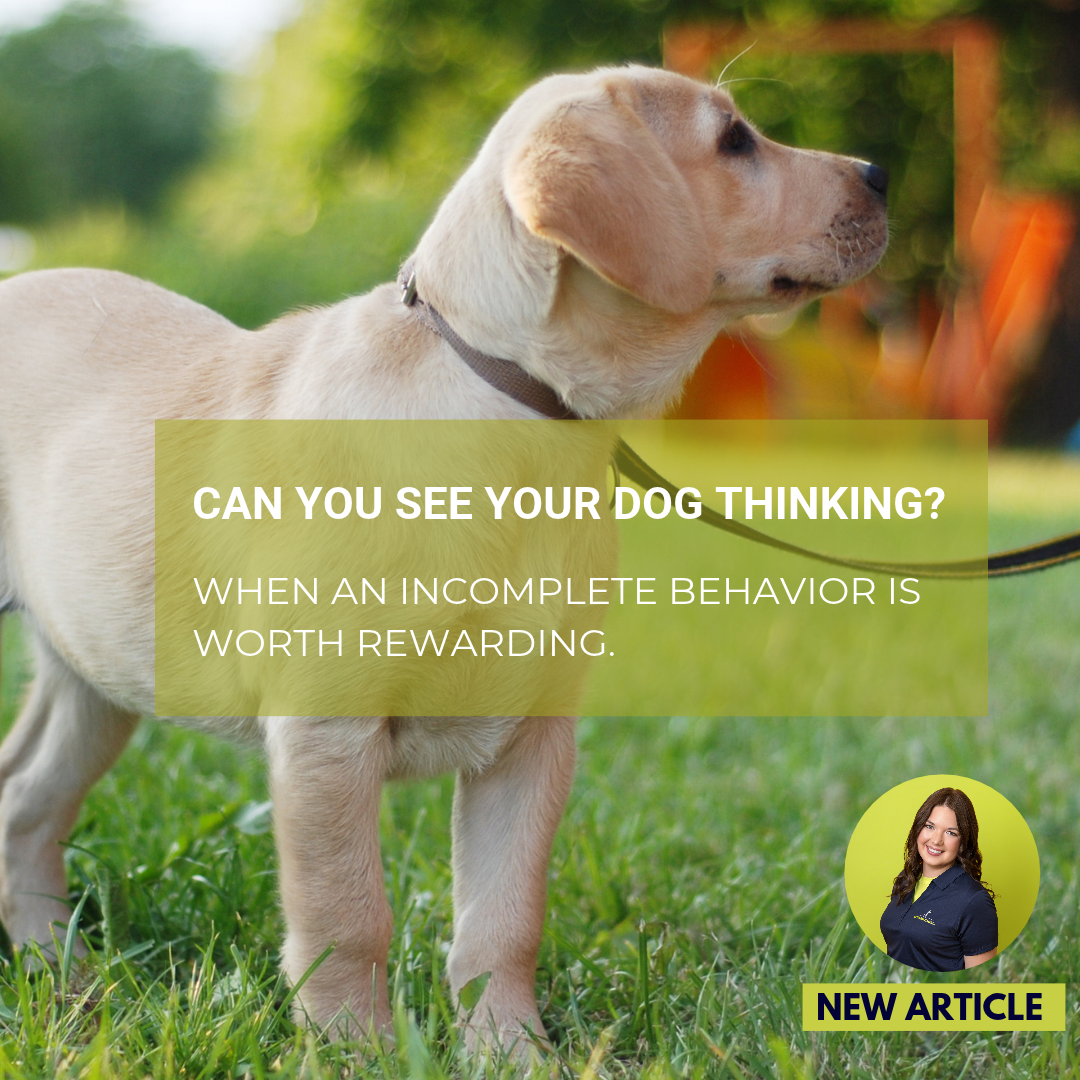
All of these things matter when you’re working toward clear cues with your dog. Training for that level of precision challenges you and your dog, but what about when your dog is learning something new? Are there ever times when we want to reward the dog for almost getting it right? How about for having the right thought? I’m not even talking about rewarding the effort alone, but that moment when you can just about see the thought as the dog is about to try something.
Rewarding the Almost-Right Answer
This brings me back to position changes because it’s such a common and useful skill that we work on. When switching between sit, down, and stand, some of the hardest transitions are popping up from down into sit and moving into stand from either down or sit. When the dog is first learning to do this at a distance, the picture changes compared to when the handler gives the cues while near the dog. Even moving away a few steps can change the picture. Sometimes, we want to reward the dog for almost getting the right answer even if they haven’t landed on it yet. When adding distance, this is one technique to consider, but don’t do it too many times in a row for the same behavior.
Now, you might ask how this even makes sense if we’re always talking about rewarding the dog for their best responses.
There are two important questions:
How do you know the dog is getting close to the correct response?
Why does this work?
It works because you’re rewarding the dog for making an attempt. Think back to that feeling when you almost know the right answer. You probably do know it, but you’re not quite sure until you get a hint. Something similar might be happening with our dogs. The behavior might be starting to click, but the dog still isn’t sure it’s the right answer.
You could reward the dog a few times for trying something that could lead to the correct response. Don’t do this for more than a few repetitions before you start raising the criteria and asking for more, though. You don’t want your dog to think the right answer is the attempt only.
Learning to See the Thought
Of course, we can never know exactly what our dogs are thinking, but we can learn to recognize when they’re about to try something.
If your dog is down and you cue a sit at a distance, they might not quite pop up the way you want, but maybe they’re just about ready to. Even if they look like they’re about to prop themselves up correctly, you might recognize the beginning of the behavior you’re looking for. You could reward that a few times and even work a treat catch into the exercise.
Be careful, because you can confuse the dog and create a situation where the dog thinks the answer is something it’s not. It takes a trained eye to recognize those moments when the dog is on the right track, and you can essentially say, “Yes, you almost had it, but here’s your hint,” through the timing and placement of your reward.
Developing your eye for those moments can be incredibly useful in training.
Giving Your Dog a Hint
The spin is another great example. You cue your dog to spin. Maybe they just start to look away from you in the direction of the spin. You can mark that movement and finish the spin with a lure until the dog starts to take that first step and make more of an effort on their own. You’re essentially giving your dog a hint by saying, “Yes, you’re on the right track, and here’s the rest of the behavior.” They’re still getting paid for it, whether that’s with a treat, play, or praise.
After just a few repetitions, you can go ahead and wait for more. You’ve rewarded the dog for trying and helped build their confidence by showing them they were on the right track. You gave them the hint they needed to finish that thought, so if they’re still not getting it on their own after one or two attempts, make the exercise easier. Help them understand it another way.
Sometimes, your dog needs a little bit more information. Other times, they’re so close to getting it right that all they need is a little hint before they have a lightbulb moment.
