What “Good” Timing Looks Like in Dog Training
Melissa Viera/Canva
All trainers will tell you that having good timing is important, but what does that actually look like? If you want to improve your timing, you have to learn how to focus on what matters in the training session. One example is the way I visualize my marker points in the ring toss trick.
The ring toss trick requires the dog to go out to a ring, pick it up, and then bring it back to a small cone (or another item) and place it over so the cone is through the ring. I consider the trick a success if the trainer can stand a few feet away from the cone. The distance demonstrates that the dog is not “accidentally” placing it correctly by bringing it towards the handler. I want the placement to be intentional. A hallmark of success with this trick is that if the dog misses, she picks up the ring and tries again.
I’ve been working on this trick with dogs of varying experience levels. Dogs with strong Trickovation micro-skills tend to pick it up quickly. Even dogs with little trick experience do well with it. The trick involves picking up the ring, holding it, and targeting the cone; that’s a lot of steps.
When it comes to planning your timing, think of the trick as a series of mini tricks that work together. First, I teach the dog to target the cone with her nose. I’ll have a few treats in my hand, with my hands at my side. It may be tempting to give the dog a lot of hints here, but I like to wait. The cone will be right next to the dog. I’m next to the cone. Eventually, the dog will look toward the cone. It might be on purpose (sniffing it), or the dog might hear a noise or just happen to move towards it. Either way, I mark this moment with “yes”. I don’t want my hand moving when I say the marker word. I’m not tossing the treat to the dog as I say “yes.” There is a brief pause, then I feed the dog. I repeat the step a few times. Then I begin to mix in a few “searches.”
I use the word “search” to tell the dog that I owe a treat (much like “yes,” but the treat will be delivered to the floor. I toss the treat out, and the dog returns to the cone. This works well for prepping for going out to get a ring later.
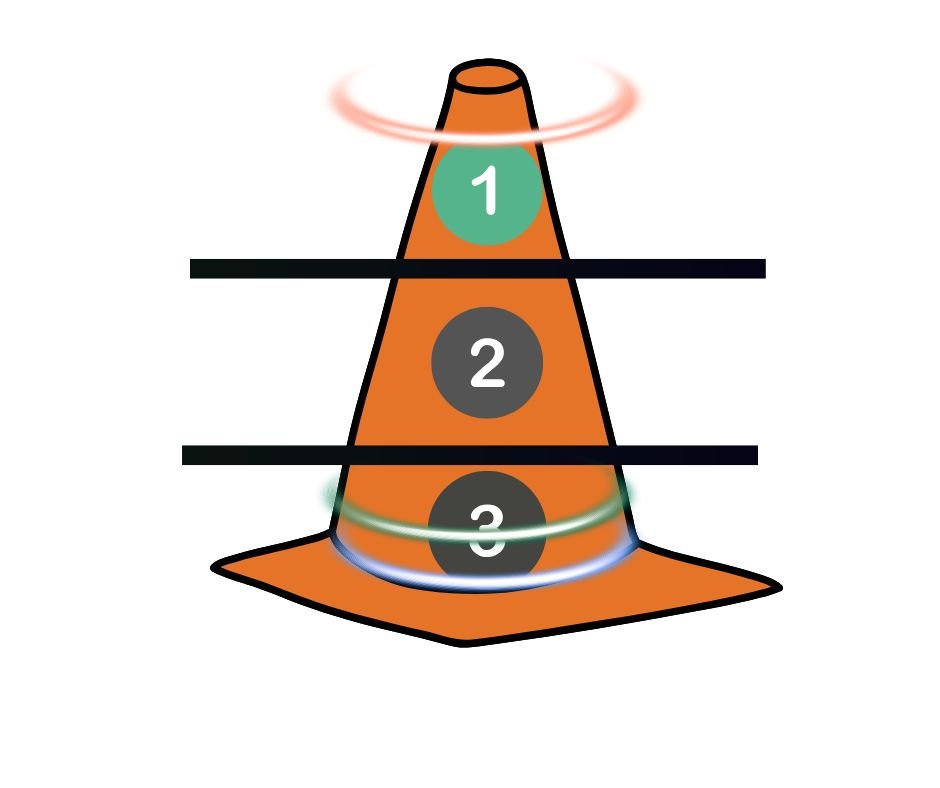
I visualize the cone split into three even sections from top to bottom. As the dog offers nose touches to the cone, the bottom sections eventually stop paying. The dog will soon only touch the top of the cone, which is what we need for the ring toss to work.
Visualization techniques help me focus on the dog, which improves my reaction time. Have you ever played a game that requires fast responses? You have to let the distractions around you blur into the background.
Having a fast reaction time when the dog is correct does not mean bouncing all over while the dog is thinking. Between marking and delivering a treat, I am still and quiet.
The next part of the trick involves picking up the ring. Some dogs will find this step easy. Others need some help.
Dogs that don’t want to pick up the ring can be convinced through another mini shaping game. I don’t just stand back like a treat machine, though. I am playing with the dog in a way that the dog appreciates. Getting the ring back to me becomes the dog’s mission because it’s so much fun.
Now, we have to combine the two. Remember how I visualized the cone in three sections? Now I work from the bottom up. I’m going to mark (yes, then feed) when the dog reaches any of the three sections at first, then only the top two, then only the top one. Again, these mental pictures help me react quickly when the dog is right.
Soon enough, the dog will accidentally place the ring in the right spot. Then it will happen on purpose. Next, I’ll move back so the dog is working with me further away.
Ring toss might seem like it’s just a trick, but as anyone who trains with me understands, these tricks are what make us think creatively, problem solve, and train incredible dogs.
