People who spend time training their dogs often notice that dogs can do some truly amazing things. When you add challenges to your dog’s training that make them think, you might be surprised by what they can do. Training isn’t just about the results. Trickovation® training challenges dogs and improves communication through various games and exercises. One game that can be interesting to work on with dogs is low-speed versus high-speed behaviors.
Why Speed Matters in Dog Training
How fast a dog moves matters for many aspects of training. While it’s important to work on skills that require stillness, we also want some skills performed at full speed. Recall is one example. When you call your dog, your dog must get to you quickly. A fast recall can prevent distraction, and it also looks impressive.
Heelwork usually requires a brisk pace, too. When you turn while your dog is heeling beside you, you don’t want to lose your dog to lagging. We consider how the dog moves in both of these exercises because it affects the result. With clear goals in mind, you can reward the motivated pace you want, which encourages the dog to maintain it.
One Behavior, Two Different Speeds
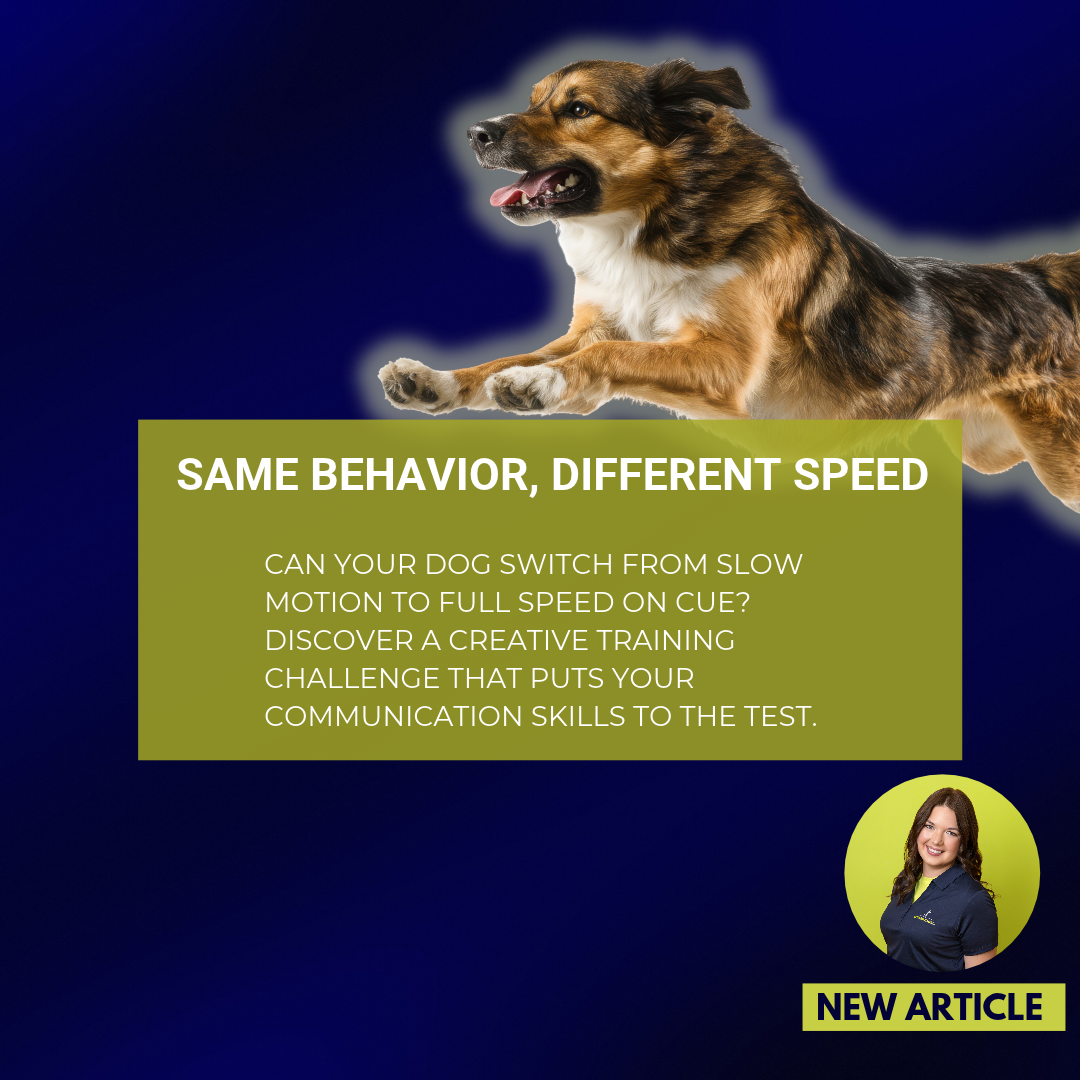
One challenge is training dogs to do the same behavior at different speeds. On the recall, you would use your regular recall cue, such as “come” or “front,” for the default, fast recall speed that you typically want. Then, you can use a cue such as “slow” before the recall for a slower speed.
Once you see this skill in action, you’ll realize why it’s so challenging to train. Dogs can switch between slow-motion steps that are far slower than their natural walk and running at full speed on cue. This exercise also challenges communication. If your dog can listen closely enough to change speeds mid-recall, you have something special.
This exercise has a few useful purposes. If your dog is walking beside you and you can cue “slow” to slow your dog down, you could use this when walking through narrow areas or carrying something. A slow recall might be helpful if you have to get your dog to you, but then you notice your dog is limping or has something else going on that makes you give the slow cue immediately.
Using Trickovation® to Train Different Speeds
To train the same behavior at multiple speeds, consider Training, Relationship, Imagination, Creativity, and Knowledge (the TRICK part of Trickovation®).
Training is the practice part. Clear communication is essential to maintaining a working relationship with your dog. You will have to use your imagination to visualize different scenarios where the skill is useful and different ways to use it. Creativity is always important because it helps you break the skill down and find positive ways to train it. Then, of course, there is knowledge. The more you understand about how your dog learns, the easier the training becomes.
Getting Started With Slow-Motion Training
You could train the default speed first and then work on the slow cue through an entirely different setup. In the beginning, it’s not a recall you’re slowing down, for example. It’s almost like you’re training something completely different. I sometimes use the focus target for this.
Once your dog can move slowly on cue, you can try it for different behaviors. Walking beside you, moving through a few obstacles, going to a target, and then, finally, the recall. While this can be challenging to train, it can also open up new ways of thinking. Consider how well you and your dog communicate during training and what other skills you could apply it to. Another thing to consider is that you could train many other tricks with a slow-speed and high-speed cue.
While this training challenge is something I would encourage all trainers to try to test their dog training skills, I think it’s great for anyone to try with their dog.
