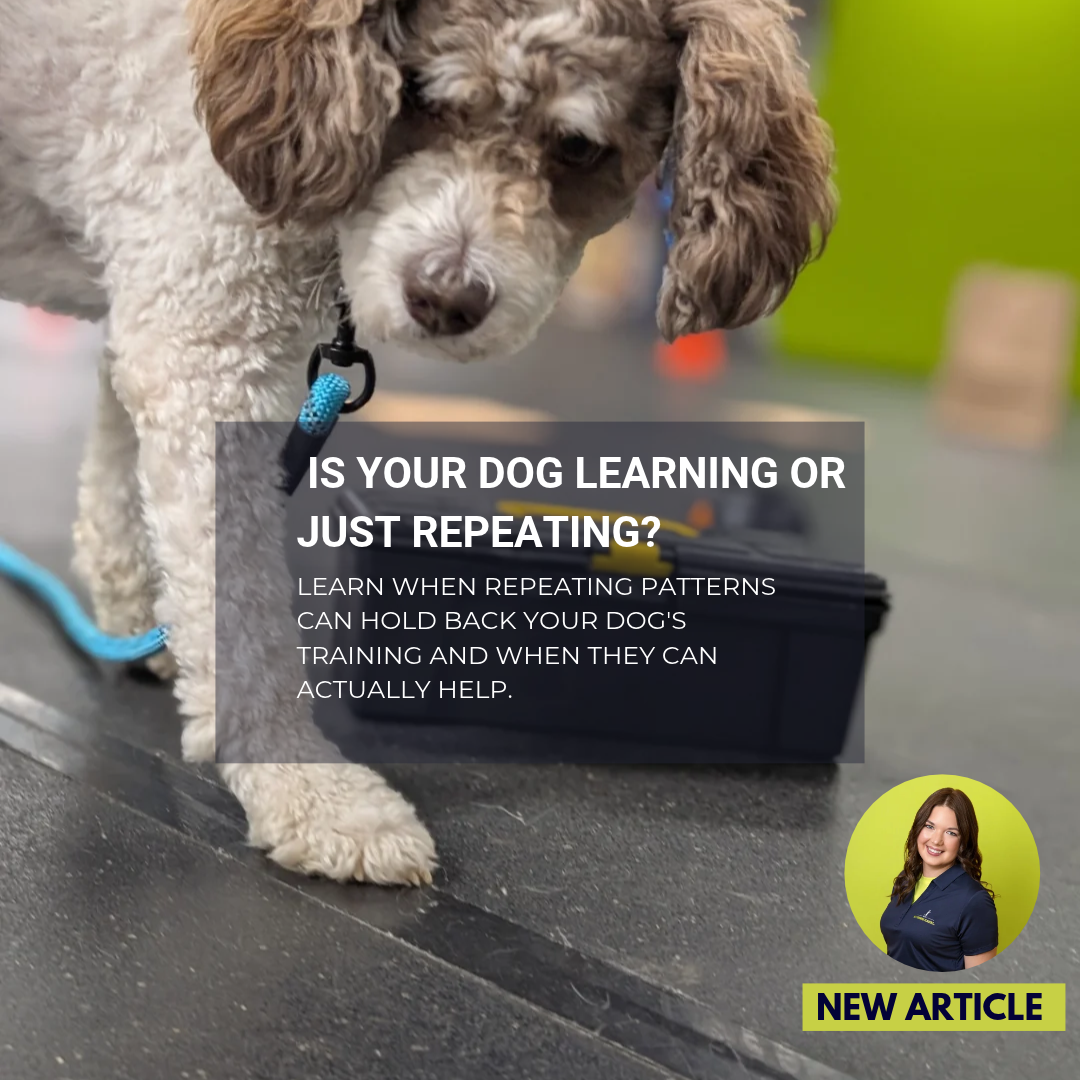
You call your dog over to work on some training. The first cue is simple. You ask your dog to sit. Instead, your dog sits, waves a paw at you, and then lies down. This is one of the most common patterns because it includes three popular skills, and the order makes them easy for the dog to perform.
If you reward your dog after the routine and then start again from the beginning, you’re stuck in a loop. Instead of your dog understanding sit on cue, paw on cue, and down on cue, your dog might simply be learning to perform the sequence. While dogs can learn routines, repeating the same pattern doesn’t necessarily help them understand each individual cue. You might also be misunderstanding what your dog truly understands.
It’s easy to get stuck in a pattern when you’re training. You might be more likely to practice the skills that are easy or that you enjoy watching your dog perform the most. Training should give you the chance to test your dog’s understanding of cues and improve communication. It’s also about giving your dog opportunities to think and learn.
Adding Variety to Training
A Trickovation® session is one example of a training session that provides variety and learning. By using micro-skills and behaviors your dog already knows, you can create new routines and teach your dog new skills. Along the way, you’ll figure out what your dog truly understands.
For example, if you use the same prop for the same skill most of the time, but then give your dog a different cue than expected, will your dog listen? This is a great way to test communication. If you tell your dog to go around a platform instead of go on it, will your cue override the sight of the platform itself?
Are Loops Ever Helpful?
Some situations call for repeating a series of behaviors. It’s not about using the same set of behaviors every time. It’s about giving the dog a very predictable pattern for a reason.
I sometimes use this with dogs working through reactivity. We start by working through a series of predictable behaviors. For example, the dog goes to a platform, then walks to a cone and circles it, then goes to a bucket and steps up.
We repeat the pattern, then add another dog. Instead of focusing only on the other dog (which can have a downside), we use the pattern to gauge the reactive dog’s response and level of improvement.
Does the dog keep going with the predictable pattern, slow down, or pause briefly to look at the incoming dog? The pattern is not a complete solution, but it’s one small piece of a unique approach to addressing reactivity successfully.
Keep Training Creative
One thing I mention often is that training requires a creative mindset. You might even find yourself being more creative than expected.
The next time you work with your dog, ask yourself whether your dog is trying anything new or repeating the same routine from the previous session. Try new skills and challenges to keep training interesting for both you and your dog.
