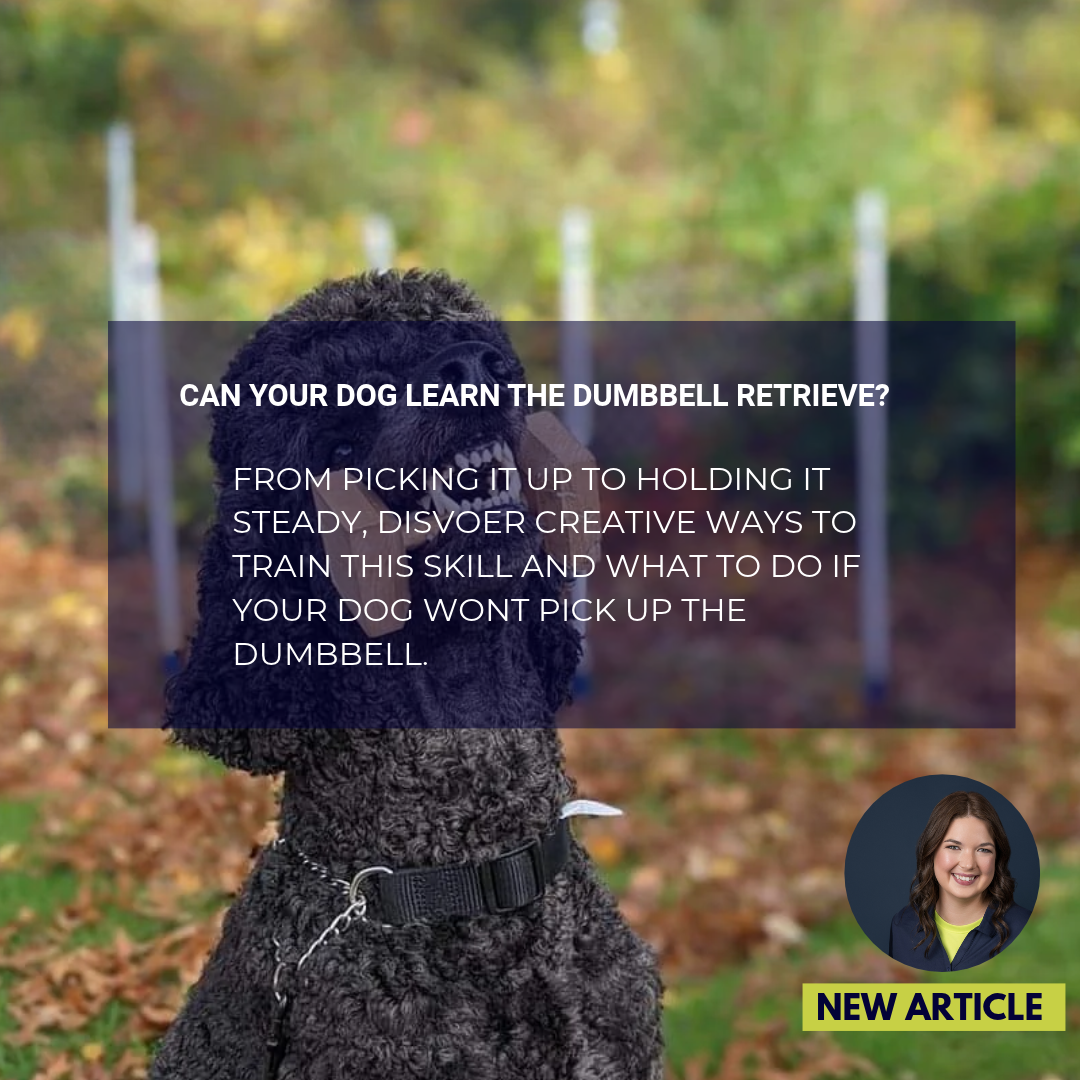
Skills that require the dog to stay still come with their own set of challenges. The dumbbell hold is a great example because dogs must learn to sit and hold the dumbbell until the handler takes it from them. Dumbbell drills are much more than a game of fetch. With a creative, patient approach, you can train your dog to retrieve on the flat and over the high jump for obedience, along with many other dumbbell drills. The key to success might be taking a Trickovation approach.
What Is the Dumbbell Retrieve?
In obedience trials, the dumbbell retrieve is a required exercise at the Open level. The dog waits at the handler’s side as the person throws the lightweight plastic or wooden dumbbell. The handler then cues the dog to “take it.” The dog runs out to the dumbbell, picks it up, and returns to the handler. The dog sits and holds the dumbbell until the person takes it.
The dumbbell retrieve at our Obedience League level of training is inspired by traditional rules but includes many more challenges, such as taking the dumbbell when it’s placed near distractions, doing various behaviors while holding it, running over food distractions with it, and more.
In Trickovation, retrieves take on a whole new style. We teach dogs to put away their toys, retrieve various items, and much more. These skills build communication and training skills. Of course, they also offer real benefits. Dogs can easily improve their drop through these training games, bring useful items to their person on cue, and even put away their toys at home.
The Biggest Challenges
Before we discuss how to train dumbbell retrieves and holds, let’s look at some of the biggest challenges. While some dogs naturally want to pick up items, others show no interest in the game. Then there are the dogs that get so excited that they’d rather zoom around than bring the item back to their person.
This skill has so many parts that need to be worked on individually. These are some of the areas where dogs can often struggle:
Running out before the cue instead of staying at the person’s side.
Dropping the dumbbell on the ground instead of holding it while sitting in front of the handler.
Rolling the dumbbell in their mouth or chewing it.
Stopping too far away from the handler instead of sitting close in front of them when returning with the dumbbell.
Having no interest in picking it up.
Refusing to pick it up if it lands too close to a ring gate or wall.
Of course, there can be many more challenges. Building a strong foundation and helping your dog understand different concepts can make dumbbell training much easier.
Picking It Up
If your dog doesn’t want to pick up the dumbbell, some easy solutions might seem strange at first but work well. Below, I’ll also cover modified drills to replace the dumbbell retrieve for dogs that can’t do it for any reason. I’ll explain why that might be the case, too.
If your dog won’t pick up the dumbbell, make sure your dog has healthy gums and teeth. Has your veterinarian ever mentioned any concerns? Does your dog pick up other items? Dogs with dental problems shouldn’t be asked to hold hard items until the concerns are addressed.
If your dog’s teeth are healthy but they don’t want to pick up the dumbbell, start with another item made from a different material. The item should only be used for training. It’s not a toy you will leave with your dog. Also make sure you can get items back from your dog if you use anything else, so they don’t try to chew it into pieces.
Some dogs do well starting with a fluffy paint roller, a paper towel roll, a magazine rolled up and covered in thick tape, or a toy with a similar shape to a dumbbell.
Just because your dog won’t pick up the dumbbell right away doesn’t mean you need one of these items, though. The training exercises below might solve the problem.
I’m not going to list every exercise I have for getting dogs to pick up the dumbbell. There are so many, and we could keep coming up with more. Instead, take the key concepts from these drills and adjust them or create new games based on them.
Take It Out of the Bucket Method
If your dog won’t pick up the dumbbell, try placing it in a low bucket. When your dog touches the dumbbell, drop a treat in the bucket. A nose touch to it is fine.
After a few rounds, drop the treat a few feet outside the bucket. When your dog touches the dumbbell, throw the treat on the floor.
If you shape this carefully, you can get your dog to offer bigger touches and eventually grab the dumbbell from the bucket and take it with them to the reward delivery spot.
This is the opposite of the tidy-up trick, but dogs will often be more likely to pick it up when they feel like they have to move it to get a bigger response from their person. That’s why the bucket works.
Another option is to use a toy that holds treats. If you place a treat in a toy and then put the toy in the bucket, will your dog pick up the toy to get it out of the bucket so they can get the treat? This gives you a very small step, but it’s a starting point for picking items up.
You can also start with a nose touch to the dumbbell on the floor, then gradually hide the dumbbell. Only reward the nose touches you can see. When the dumbbell is fully hidden behind another object, some dogs will go through an extinction burst when you stop treating. They get so motivated to figure out what works that they grab it and bring it out from where you placed it.
Shaping
You can completely shape the dumbbell hold in small steps without games or props, but from the handler’s perspective, it can help to set goals like taking it from the bucket rather than just picking it up from the ground.
It all depends on the person and the dog, but I think it’s fun to have these little challenges.
Learning Through Play
Some dogs learn the dumbbell retrieve well through play. Presenting the dumbbell, then taking it away, moving it away from the dog, or going right to throwing it are all ideas to try.
You can also start training by playing with the dog using a tug toy, then placing the dumbbell down. When the dog picks up the dumbbell, switch back to the tug toy for the reward.
How to Train Dogs to Hold the Dumbbell
Picking up the dumbbell is one thing, but how do you actually get your dog to hold it without dropping it?
One technique is training the concept of stillness first. A game to try without the dumbbell is holding a few treats in one hand. When your dog offers stillness on their own, open your hand, take a treat out, and feed your dog. When your dog is wiggling around, close your hand.
An open hand means the dog is correct, and a closed hand means try something else.
Once the dog understands the concept, try it with various tricks. Does the dog understand the stillness game with taking a bow, paws up, or even holding one paw on a target?
Essentially, an open hand tells the dog to freeze and continue holding the position until released. They get fed from the open hand at random times, but if they move before being released, the handler closes their hand, and the dog is not rewarded.
One common thing people experience when they begin training dumbbell holds is that dogs spit out the dumbbell because the person reaches for a treat or the dog wants to get to the food.
The open- and closed-hand drill helps fix that.
Remember, taking the Trickovation approach means looking at things through a creative lens and imagining what’s possible. Help your dog understand the concept first, then add the dumbbell to the mix, and it’s a lot easier.
An open hand tells the dog they are doing the right thing when they hold the dumbbell steady without chewing or rolling it. A closed hand is for when they drop it without being cued to.
You can mark and feed randomly from the open hand. Of course, they have to let go of the dumbbell to take the treat. You won’t keep treats in your hand later. This trains the hold at the beginning.
Another great exercise to try without the open-hand game is getting the dog to move while holding the dumbbell.
If the dog can pick up the dumbbell easily from the ground but they drop it too fast, try encouraging the dog to move, spin, jump up onto a platform, or do something else.
If they hold the dumbbell through that movement, throw a party for your dog. That’s a great start.
Other Challenges
Once dogs can both pick up and hold the dumbbell, you can begin doing more with it. Instead of practicing the same style of retrieve every time, Trickovation calls for a more unique approach.
For example, I like to place the dumbbell on a shelf vertically or balance it on a cone to teach the dog to turn their head to pick it up.
We place it next to objects, hide it, let the dogs choose their own dumbbell from a pile of others, and much more.
It’s not just about bringing the dumbbell, either. I like to see if dogs can go to targets while carrying the dumbbell, do a step-up, and perform other behaviors.
What If Your Dog Still Won’t Pick It Up?
For some dogs, it can take a long time. If your dog doesn’t play with toys, is newly rescued, or rarely picks up anything, you’ll need to be patient.
Keep dumbbell training sessions very short. Try using an item other than the actual dumbbell for training as well.
One of my favorite approaches is using food-stuffed items placed in a bucket so the dog has to take the item out to get the food.
Never force your dog to hold an item. There’s no reason to make your dog feel forced or pressured to pick up an item. If you make training into a game and have fun with it, your dog will likely get it.
Sometimes dogs don’t like to hold items. Maybe they associate holding with pain from a tooth that was once broken, even if it has since been extracted. Maybe there’s another reason.
Plenty of other skills require similar movements, like going out to touch a nose target and returning, pushing an item back instead of carrying it, and more.
If your dog is a little hesitant, take your time, have fun, and keep trying as your dog builds confidence and trust with the game. In the meantime, you can use other tricks and games that offer similar challenges.
How Long to Practice
As a general rule, keep your dumbbell training sessions brief at first. Put the dumbbell or other item away when you’re not training.
You might be excited about your dog’s progress as your dog starts to understand what you want, but don’t overtrain and bore your dog.
Sometimes the training goes faster than expected. Often, Trickovation leads to fast results. You might be surprised when it all clicks for your dog sooner than expected, but don’t rush or compare your dog with others.
Have fun, and remember your dog is doing amazing no matter what. So are you for putting all this thought and time into training.
